

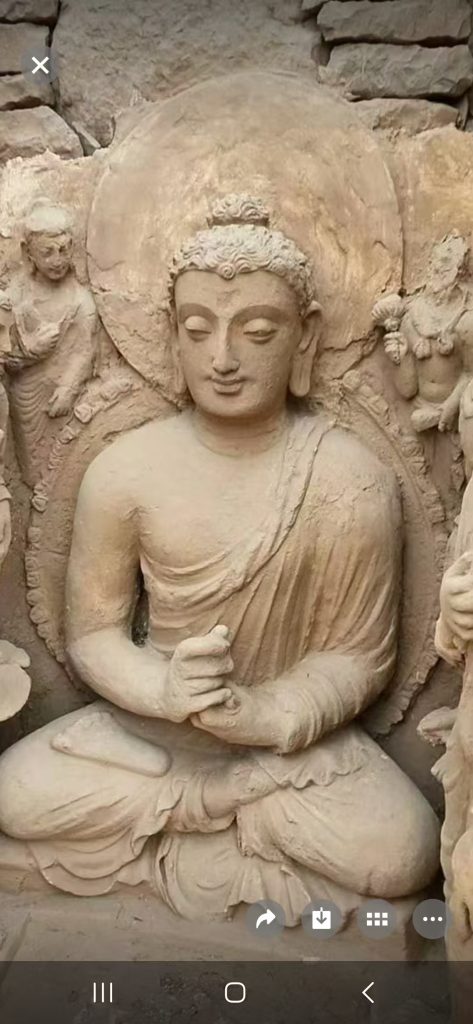
**Opening Verse**
Six years of ascetic practice, on Laba night he glimpsed the stars and awakened,
How wondrous! How wondrous! The original nature of sentient beings and Buddha is the same,
The Buddha Way complete, for forty-nine years he expounded the teachings,
Generation after generation, our patriarchs carried forward what came before and opened paths for those to follow,
The three minds and four marks suddenly penetrated—the marvelous existence and emptiness.
Self-awakened and awakening others, breaking apart the traces of ignorance,
Mind gives rise to myriad dharmas, and all dharmas return and dissolve into mind,
Standing firm, moving freely in all directions, at ease among a hundred red flowers.
**Historical Account**
The eighth day of the twelfth lunar month, known as Laba Festival, is also called Dharma Treasure Day, Buddha’s Enlightenment Day, or the Enlightenment Assembly. The origins of Laba Festival begin with the birth of Prince Siddhartha, the prince of the kingdom of Kapilavastu. He was born in Lumbini Garden, in present-day Nepal, and belonged to the Shakya clan. His father was King Śuddhodana. Prince Siddhartha renounced his royal position and left the palace at midnight to become a monk. He sought teachers and the Way, and although he practiced diligently, none of these efforts led him to ultimate perfect enlightenment. He then entered the ascetic forest near Gayā Mountain in the kingdom of Magadha to practice various austerities.
He ate only one sesame seed and one grain of wheat per day. This asceticism caused his body to become extremely weak, reduced to skin and bones. Six years of ascetic practice passed, yet the great matter remained unresolved. The prince reflected on the deficiencies in his cultivation and gradually realized that austerities were merely auxiliary conditions for attaining the Way, not the direct cause of enlightenment. Extreme asceticism ultimately could not lead to the realization of ultimate truth and perfect enlightenment.
He then rose from his seat and walked, but collapsed unconscious by the banks of the Nairañjanā River due to exhaustion. Afterward, he accepted an offering of milk porridge from a shepherdess. Once his strength was restored, the prince crossed the Nairañjanā River and sat upon a cushion of kusha grass at the Diamond Seat beneath a flourishing pippala tree (Bodhi tree). He made a vow that he would not leave this seat until he attained perfect enlightenment. Seven days later, in the deep night of Laba, he gazed upon the stars and achieved great awakening. He then declared: “How wondrous! How wondrous! All sentient beings possess the wisdom and virtuous characteristics of the Tathāgata, but due to delusive thinking and attachments, they fail to realize it.”
**The Shepherdess’s Offering of Milk Porridge to the Buddha**
This is a pivotal episode in the story of the Buddha’s enlightenment. It describes how, after six years of ascetic practice, Prince Siddhartha’s body had become extremely weak. By the banks of the Nairañjanā River, he accepted an offering of milk porridge from the shepherdess Sujata, which restored his strength. He ultimately attained enlightenment beneath the Bodhi tree. This story inspired Chinese Buddhists to cook Laba porridge on the eighth day of the twelfth lunar month (Buddha’s Enlightenment Day / Dharma Treasure Day) as an offering to the Buddha and to share with the community. This practice gradually evolved into a folk custom.
**Summary of the Story**
*Six years of ascetic practice:* In his quest for truth, Prince Siddhartha practiced austerities beneath the Bodhi tree for six years, eating only one sesame seed and one grain of wheat per day. His body became extremely emaciated, nearly withered away.
*Physical collapse:* After realizing that asceticism was not the ultimate path, the prince abandoned his austerities. While bathing in the Nairañjanā River, he collapsed unconscious on the riverbank due to exhaustion.
*The shepherdess’s compassion:* A shepherdess named Sujata was tending her flock by the river. Seeing the prince unconscious, she felt compassion and offered him the milk porridge (rice cooked with milk) that she had originally prepared as an offering to the gods.
*Restoration of strength:* After consuming the milk porridge, the prince’s body was nourished and his strength gradually returned.
*Enlightenment:* With his strength restored, the prince crossed the Nairañjanā River, walked to the Bodhi tree, laid kusha grass upon the Diamond Seat, and sat in proper contemplation. He vowed not to leave this seat until he attained perfect enlightenment. Finally, in the deep night of the eighth day of the twelfth month (Laba), he gazed upon the morning star and achieved complete awakening, realizing Buddhahood.
**Connection to Laba Porridge**
Chinese Buddhists commemorate the Buddha’s enlightenment and the shepherdess’s virtuous offering by emulating her gift of milk porridge. On the eighth day of the twelfth lunar month, they typically cook porridge using rice, various grains, and fruits (though what the Buddha actually consumed was simply porridge made from milk and rice). This porridge is offered to the Buddha or shared with devotees and is called “Laba porridge.” This is the origin of Laba.